

AI Usage in Indonesia: What the Data Reveals About Adoption, Usage Patterns, and Integration Readiness
06 Jan, 2026
- 21,002 views

2016 - 2026 Copyright @ Graphie.
All Rights Reserved
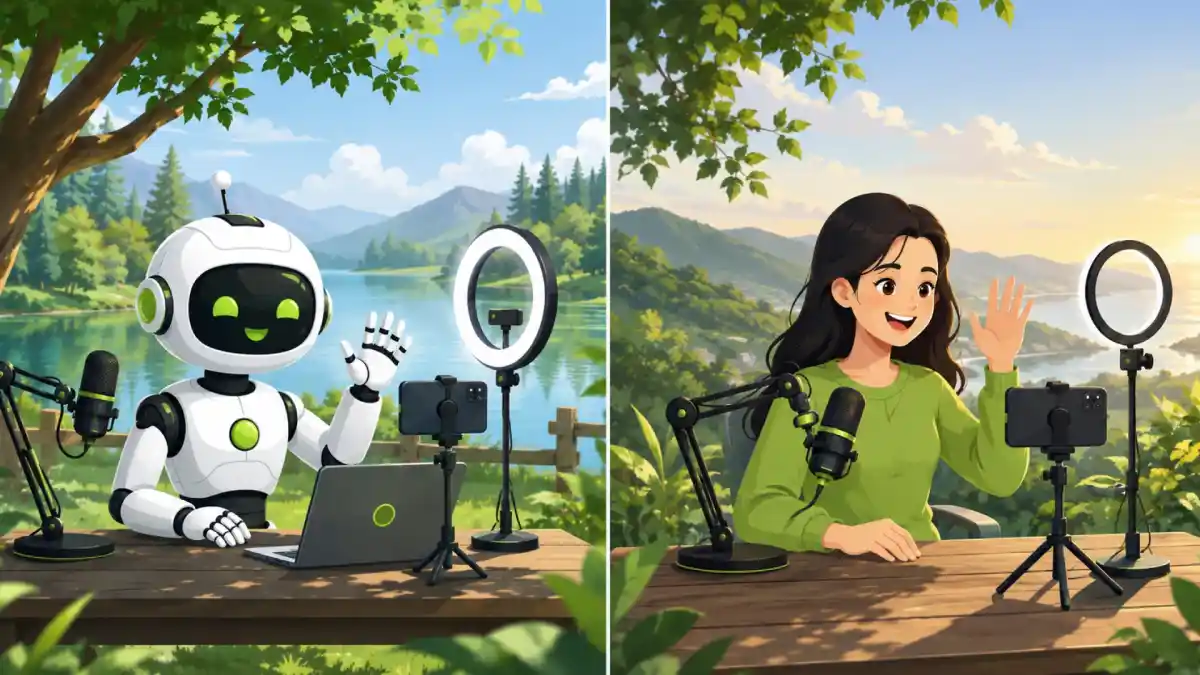
There was a time when creating social media content meant relying on a creative team, photographers, videographers, copywriters, designers, and editors. Today, a single person with the help of AI can generate dozens of ideas, captions, images, videos, and even ad variations in a fraction of the time. Content production has become faster, cheaper, and more scalable. But as almost everyone becomes capable of producing content that looks good, a much more interesting question emerges: what kind of content do people actually like?
Do audiences prefer content created by humans? Do they simply not care as long as the content is interesting? Or can AI actually create more engaging content because it can analyze patterns, trends, and the things that typically make people stop scrolling?
The answer is not as simple as AI vs. humans.
What matters more is what happens to likes, comments, shares, trust, and the desire to keep following a channel or brand. Because on social media, the goal is not simply to make people see your content. The real goal is to make them want to interact with it.
Social media has become a major part of our digital lives. A 2026 study published in the Journal of Consumer Research noted that consumers worldwide spend more than two hours a day on social media, while more than 94% of internet users globally use social media every month.
That means every brand is competing in an incredibly crowded environment.
AI is making that environment even more crowded. A 2026 study published in Scientific Reports, involving 680 participants, found that the use of AI in social media environments can increase content volume and, under certain conditions, increase engagement. But there is an interesting trade-off: as AI use increases, perceived conversation quality and authenticity can also decline.
In other words, AI makes it increasingly easy to produce content, but that does not necessarily make it easier to make people care.
And perhaps this is the biggest challenge for social media marketing in the AI era:
As content becomes easier to create, human attention becomes harder to earn.
In the early days of generative AI, identifying AI-generated content was relatively easy. Strange-looking hands, unnatural faces, overly polished writing, or awkward video movements often gave it away.
Konsultasi GRATIS tanpa Komitmen, dan temukan strategi terbaik untuk bisnis Anda.
CHAT SEKARANGThat is changing rapidly. AI can now produce images, videos, and copy that are increasingly difficult to distinguish from human-created work. Research published in the Journal of Consumer Research in 2026 noted that AI can now generate high-quality media that is often difficult to distinguish from human-created content.
So the question is no longer simply: “Can people tell that this was made by AI?” The more important question is: “What happens to engagement when they know?” And this is where the data becomes particularly interesting.
A 2026 study published in the Journal of Consumer Research did something remarkable. Researchers analyzed more than 1.1 million TikTok posts from 8,650 creators to examine the relationship between AI disclosure and engagement. The researchers also conducted a series of experiments involving a total of 3,396 participants.
The findings were surprising.
Posts carrying an AI-generated label showed lower engagement than posts without the label. In descriptive data collected after TikTok's disclosure policy was introduced, unlabeled posts averaged roughly 908 likes, 11.2 comments, and 31.8 shares, while labeled AI posts averaged around 297 likes, 7.5 comments, and 4 shares.
However, there is an important caveat: this is a comparison between posts with and without AI disclosure, not a simple controlled comparison of “100% AI vs. 100% human” content. Therefore, these numbers should not be interpreted as proof that all AI content automatically performs worse.
What is more interesting is why engagement may decline.
The researchers found that the effect was not simply explained by poorer content quality or by audiences universally disliking AI. One important mechanism was parasocial connection—the sense of emotional closeness audiences develop with creators. When audiences know that AI played a role in creating content, their perception of the human effort behind that content can change.
That leads to an important insight:
People don't only interact with content. They also interact with the human being behind the content.
This is something social media marketing often overlooks.
We tend to put everything under the umbrella of engagement, even though a like and a share can mean very different things. A like requires very little effort. One tap is enough. A comment requires more effort because the person has to have something to say. A save suggests that the content is valuable enough to revisit. A share is even more interesting. When someone shares a piece of content, they are essentially telling someone else:
“This is interesting. You should see this too.”
Then there is another form of engagement that is particularly valuable for a brand:
The follow.
A follow means someone does not simply like one piece of content. They want to see what comes next. That is why a post with 10,000 likes is not necessarily more valuable than a post with 3,000 likes that generates 500 comments, 1,000 shares, and 2,000 new followers. Social media is not only about how many people see us. It is about how many people want to see us again.
The answer is: it can. And this distinction is important because we should not fall into the assumption that “human content is always better.”
The Scientific Reports study found that certain uses of AI can increase engagement and the volume of content being produced. AI can help creators generate ideas, formulate responses, and produce significantly more content. The logic is straightforward. AI can help creators generate more:
Imagine a social media manager who normally develops 10 concepts.
With AI, they might explore 100. Perhaps only five of those 100 are genuinely great.
But without AI, those five ideas might never have been discovered. AI is therefore not simply a content-generation machine. It can become a creative exploration engine. And this is where AI has an advantage that is difficult for humans to match:
Imagine two accounts. The first produces 20 pieces of content a month. Each one is highly personal, built around real experiences, opinions, humor, stories, and a distinctive point of view. The second produces 200 pieces of content a month with the help of AI. Statistically, the second account has far more opportunities to discover something that goes viral.
But will its audience feel closer to the brand? Not necessarily. The Scientific Reports research points to precisely this duality: AI can increase content volume and certain forms of engagement, while its use can also reduce perceptions of quality and authenticity in interactions. This creates an interesting paradox:
AI can help a brand speak more. But speaking more does not automatically make an audience feel closer.
Another 2026 study published in Electronic Markets examined how AI labeling affects social media engagement. Across two online experiments involving 325 and 371 participants, researchers found that labeling content as AI-generated or AI-enhanced could reduce both affective and behavioral engagement compared with human-created content, particularly for emotionally oriented content.
Again, context matters.
This does not mean that simply using AI will automatically destroy engagement. What the research suggests is that audience perceptions of AI involvement can influence how people respond to content, especially when the content depends heavily on emotional connection.
That makes intuitive sense. If a brand is sharing information about a software feature, using AI may not matter very much. But if a brand is telling the founder's story, sharing a customer's personal experience, talking about family, or discussing something deeply emotional, audiences may care about a different question: “Was this actually experienced by a human?”
This is why overly perfect content can sometimes feel less interesting. The product photo is perfect. The lighting is perfect. The face is perfect. The background is perfect. The caption is perfect. But humans are not perfect.
Sometimes a slightly blurry photograph feels more personal. A video that is not overly scripted can feel more honest. A caption written in everyday language can feel more relatable. A creator admitting a mistake can feel more human. And that imperfection can become part of the appeal.
Authenticity does not mean that content has to look bad. Authenticity means that the content feels like there is a human being behind it.
This may be the most important takeaway of all. The issue is not whether we use AI. The issue is what we use AI for. There is a major difference between: “AI created this entire piece of content.” and: “A human created the idea and story, while AI helped accelerate the production process.”
In the second scenario, AI is not replacing the human. AI becomes a creative amplifier.
Humans still decide:
AI can then help answer:
This is where the combination of human creativity and AI becomes much more interesting than choosing one over the other.
Ultimately, audiences do not open Instagram, TikTok, or LinkedIn to admire the technology a brand used to produce its content. They come to be entertained, learn something, find inspiration, feel represented, laugh, become curious, or connect with something.
AI can help us achieve all of those things. But AI does not automatically guarantee success. A piece of content can be shot with a camera worth tens of thousands of dollars and still receive almost no attention. A video can be created with the most advanced AI tools and still get no shares. Meanwhile, a simple smartphone video can generate thousands of comments because the story feels close to people's lives.
So perhaps we have been asking the wrong question.
Not: “AI or human?” But: “Does this content make people want to do something?” Do they want to like it? Do they want to comment? Do they want to send it to a friend? Do they want to save it? Do they want to follow the account? And most importantly: Do they want to come back tomorrow?
AI will continue to become part of the content production process. And that is not something brands should fear.
In fact, brands that know how to use AI effectively will gain significant advantages in speed, volume, personalization, experimentation, and data-driven optimization. But as content becomes easier to produce, something that cannot be created simply by pressing a button becomes increasingly valuable: Perspective. Experience. Empathy. Humor. Culture. Story. And a reason to care.
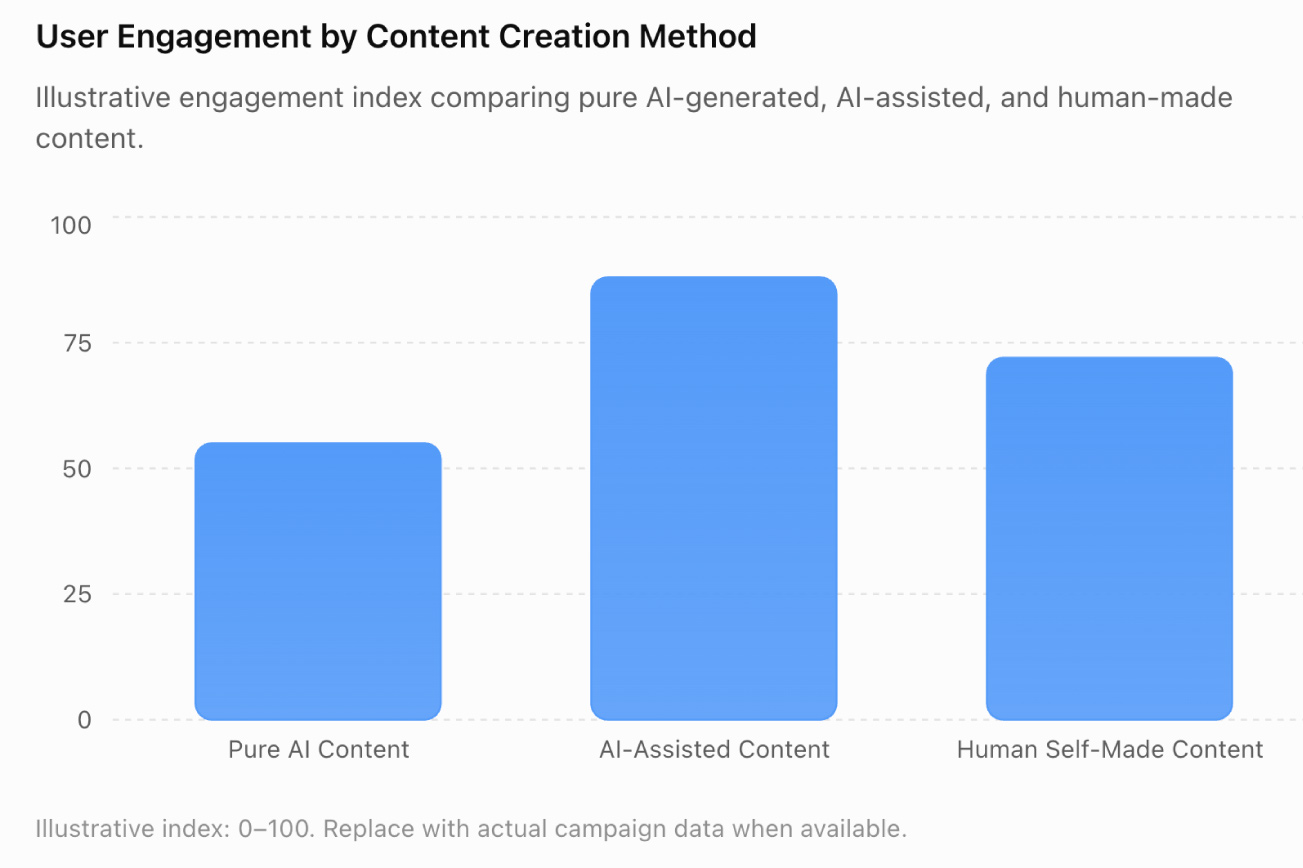
AI can generate a hundred versions of an idea. But humans still have to decide which idea is worth pursuing. AI can make content faster. But humans decide what is worth saying. AI can help a brand speak to millions of people. But humans still determine what makes someone feel like they are being spoken to personally.
Perhaps that is why the future of social media is not:
It is:
Because when everyone can create content with AI, a brand's advantage will no longer be who can produce the most content.
The advantage will belong to whoever can create content that makes people say: “That is so me.” “I have to share this.” “I want to see more from them.”
And perhaps, in a world increasingly filled with machine-generated content, the most valuable thing of all will be something that still feels unmistakably human.
Content that is not only seen, but felt.



Recommended for you
AI Usage in Indonesia: What the Data Reveals About Adoption, Usage Patterns, and Integration Readiness
The Best Power-Ups and Boosters in Ducky Pop: When and How to Use Them
The Hydrogen Fuel Frontier: Aryanto Misel's Nikuba Tech Shakes the World
The Psychology Behind Match-3 Games: Why Ducky Pop is So Addictive
Feeding the Future: Tackling Global Food Security with AI Agriculture
Ducky Pop: A Splash in the Match-3 Pool
From Idea to Launch: A Step-by-Step Guide to Building Your Dream Startup
The Digital Revolution: How Mobile Apps Have Transformed Our Daily Lives
Unlock the Hidden Worlds: Exploring the Different Themes and Levels in Ducky Pop
Tonework: The Future of Personalized Beauty is Here
Typography Tips That Wow: How to Use Fonts Like a Pro
Ducky Pop: A Splash in the Match-3 Pool
The Future of Website Design: AI-Driven Tools Transforming User Experience
The Power of Data Analytics: How to Drive Growth with Informed Decisions
From Zero to Branded Hero: How Print-on-Demand Empowers Small Businesses