

AI Usage in Indonesia: What the Data Reveals About Adoption, Usage Patterns, and Integration Readiness
06 Jan, 2026
- 20,916 views

2016 - 2026 Copyright @ Graphie.
All Rights Reserved
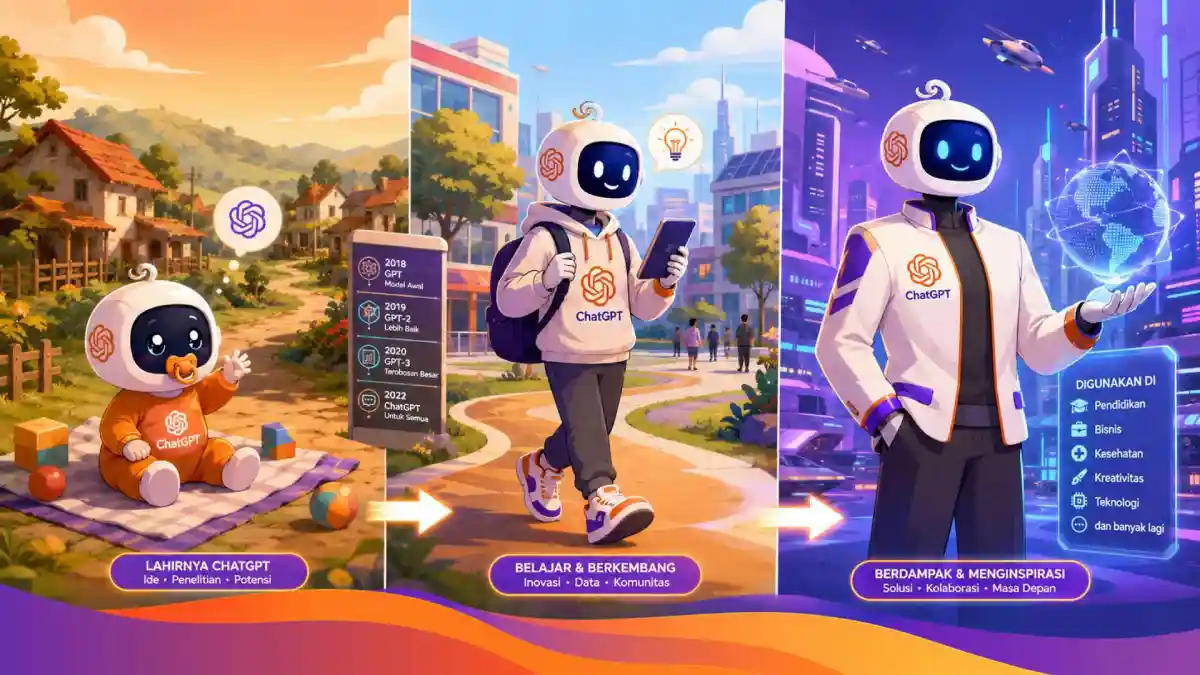
Imagine the world before ChatGPT. When people wanted to find something, they searched Google. When they needed to write an email, they wrote it themselves. When they had to create a presentation, they started with a blank page. Artificial intelligence already existed, but for most people, it was something working quietly behind the scenes.
Konsultasi GRATIS tanpa Komitmen, dan temukan strategi terbaik untuk bisnis Anda.
CHAT SEKARANGAI had already become part of everyday life long before ChatGPT appeared. Algorithms recommended videos, search engines ranked information, and navigation apps calculated the best routes. Yet most people rarely interacted directly with artificial intelligence. AI was there, but it remained largely invisible.
Then, at the end of 2022, something changed. A simple conversational interface appeared on the internet under the name ChatGPT. Users could type a question or instruction and receive a response that felt remarkably natural. For the first time, AI felt like something anyone could actually talk to.
To understand why ChatGPT became so successful, we need to go back several years. In 2015, OpenAI was founded with an ambitious mission to develop artificial general intelligence that could benefit humanity. One of its major areas of research eventually focused on teaching machines to understand and generate human language.
In 2018, OpenAI introduced GPT-1, short for Generative Pre-trained Transformer. Its capabilities were extremely limited compared with today's AI models. Yet GPT-1 introduced an important idea: a model could first learn from enormous amounts of text and then use that knowledge to perform different tasks.
A year later, OpenAI introduced GPT-2. The model could generate text that was significantly more natural and convincing. Its capabilities also raised concerns about the potential misuse of AI to produce misinformation or harmful content at scale.
GPT-2 became an early indication that generative AI could be much more powerful than a simple research experiment. Machines were beginning to produce something that had traditionally been associated with humans: coherent and context-aware language.
In 2020, OpenAI introduced GPT-3, a model that was dramatically larger than its predecessors. With 175 billion parameters, GPT-3 demonstrated an impressive ability to perform different tasks based largely on natural-language instructions.
It could write, summarize, translate, answer questions, generate code, and perform many other tasks. But the most important development was not simply the model's size. It was the realization that one underlying technology could support many different applications.
OpenAI made GPT-3 available through an API, allowing developers to build their own products on top of the model. Artificial intelligence was beginning to evolve from a research project into a platform.
Yet GPT-3 was still not a global consumer phenomenon. Most people had never interacted directly with it. The technology was powerful, but it had not yet found the simplest possible interface.
Then came ChatGPT.
On November 30, 2022, OpenAI introduced ChatGPT to the public. Technically, ChatGPT was not the beginning of OpenAI's AI journey. It was the result of years of research, experimentation, and model development.
What made ChatGPT different was how the technology was presented. Users did not need to understand programming, machine learning, APIs, or technical documentation. They simply had to open the application, type something, and start a conversation.
That simplicity became one of the most important factors behind its success. A technology that had previously been accessible mainly to researchers and developers suddenly became available to students, professionals, business owners, creators, programmers, and everyday users.
Within a remarkably short period of time, ChatGPT became a global phenomenon. People started using it to write emails, create articles, complete assignments, translate languages, generate code, brainstorm ideas, plan businesses, and simply explore what an AI could do.
This is where the success of ChatGPT becomes particularly interesting. Artificial intelligence had already been used by millions of people before ChatGPT, but most of it operated behind the scenes. ChatGPT changed that relationship by allowing people to interact directly with an AI system.
For decades, people learned to use computers through buttons, menus, applications, and specialized interfaces. ChatGPT introduced another possibility: human language itself could become the interface for interacting with computers.
People no longer needed to understand how a system worked before they could benefit from it. They could simply describe what they wanted in everyday language and let the AI attempt to turn that instruction into a useful result.
The change may have looked simple, but its implications were enormous. Artificial intelligence was no longer something that felt like a distant technology of the future. It had become a tool that anyone could use today.
In March 2023, OpenAI introduced GPT-4. The model significantly improved AI capabilities across areas such as reasoning, writing, coding, analysis, and understanding more complex instructions.
This development pushed AI further into professional work. Programmers could use it to understand and generate code, marketers could use it for brainstorming, and businesses could explore ways to integrate AI into their daily operations.
AI was beginning to evolve from a chatbot into an assistant. That distinction was important. A chatbot primarily provides answers, while an assistant can help people accomplish tasks.
The question surrounding AI therefore began to change. People were no longer asking only, "What can AI do?" They were increasingly asking, "What work can AI help me accomplish?"
ChatGPT's success did not go unnoticed. Other major technology companies quickly entered the race. Google developed Gemini, Anthropic built Claude, Meta pushed its Llama models, and Microsoft expanded AI capabilities across its products through Copilot and other enterprise solutions.
The competition was no longer simply about building the smartest model. Companies began competing to build entire AI ecosystems involving models, computing infrastructure, developers, applications, enterprise customers, and distribution.
Artificial intelligence became one of the largest technology races in the world. Companies were competing for a position in an emerging ecosystem that could fundamentally change how people work and interact with software.
ChatGPT itself continued evolving from a simple chatbot into a broader platform. Voice interaction, image generation, file analysis, custom GPTs, tools, connectors, and increasingly agentic capabilities expanded what people could accomplish with AI.
The evolution of ChatGPT represents a fundamental shift in how people use AI. Early generative AI was primarily used to answer questions, generate text, and provide information based on user instructions.
Over time, AI began handling more complex tasks. Users could provide documents for analysis, ask AI to create reports, generate software code, conduct research, organize information, or help develop business strategies.
The difference can be summarized simply. Early AI essentially said, "Here is the information you need." The next generation began saying, "Here is the work I helped you complete."
This shift is leading toward the concept of AI agents. If a chatbot allows humans to communicate with computers, an AI agent could eventually help computers execute a series of actions based on a goal defined by a human.
That represents a much bigger change than simply having a smarter chatbot.
The success of ChatGPT cannot be explained by model intelligence alone. Timing played a major role. Generative AI had become capable enough to deliver surprising results, while society was already comfortable with cloud-based digital products and conversational interfaces.
Simplicity was another critical factor. ChatGPT did not require users to learn a new technical system before they could use it. People could communicate with it using the same language they already used every day.
Distribution also mattered enormously. When someone discovered an impressive use for ChatGPT, they could easily share the result with others. Users effectively became part of the product's growth engine.
Perhaps most importantly, ChatGPT continued to evolve. It was never treated as a finished product. Models, reasoning capabilities, multimodal interaction, tools, and new features continued expanding what the platform could do.
Perhaps the greatest impact of ChatGPT is not simply the number of people using it, but how it has changed the way businesses think about software.
For decades, companies purchased software to help people perform specific tasks. CRM systems managed customers, ERP systems managed operations, HRIS platforms managed employees, and countless other applications helped organizations store and process information.
AI introduces a different possibility. What if software could not only store information, but also understand it, analyze it, provide recommendations, and help execute the work?
That question opens an enormous opportunity for businesses. AI could become a new intelligence layer on top of existing software, changing not only what software can do, but also how humans interact with it.
The history of ChatGPT teaches an important lesson: the most advanced technology does not automatically become the most successful product.
GPT-1 introduced the foundation. GPT-2 demonstrated the potential. GPT-3 opened the door to a broader platform. But ChatGPT brought the technology to the world in a form that ordinary people could understand and use.
The real innovation was therefore not only the intelligence of the underlying model. It was the ability to transform extremely complex technology into an experience that felt remarkably simple.
Innovation is not just about how advanced a technology can become. It is also about how easily people can access and benefit from it.
ChatGPT successfully connected the world of artificial intelligence with everyday life. A technology that once seemed complex and distant suddenly became accessible through something as natural as a conversation.
Looking at the journey from GPT-1 to today's ChatGPT, the transformation is remarkable. What began as a research experiment evolved into a platform used across education, software development, business, research, content creation, and everyday life.
But we may still be looking at only the beginning of the story. The biggest question for the future is no longer simply how intelligent AI can become.
The more important question is how much work humans will eventually be comfortable delegating to AI.
If computers allowed humans to calculate faster, the internet allowed us to access information faster, and smartphones allowed us to stay connected everywhere, AI may represent the next major shift: helping humans work alongside digital intelligence.
And perhaps the history of ChatGPT will ultimately be remembered as more than the story of a successful chatbot.
It may be remembered as the moment when humans began developing a new relationship with technology—not simply using computers, but working alongside artificial intelligence.



Recommended for you
AI Usage in Indonesia: What the Data Reveals About Adoption, Usage Patterns, and Integration Readiness
The Best Power-Ups and Boosters in Ducky Pop: When and How to Use Them
The Hydrogen Fuel Frontier: Aryanto Misel's Nikuba Tech Shakes the World
The Psychology Behind Match-3 Games: Why Ducky Pop is So Addictive
Feeding the Future: Tackling Global Food Security with AI Agriculture
Ducky Pop: A Splash in the Match-3 Pool
From Idea to Launch: A Step-by-Step Guide to Building Your Dream Startup
The Digital Revolution: How Mobile Apps Have Transformed Our Daily Lives
Unlock the Hidden Worlds: Exploring the Different Themes and Levels in Ducky Pop
Tonework: The Future of Personalized Beauty is Here
Typography Tips That Wow: How to Use Fonts Like a Pro
Ducky Pop: A Splash in the Match-3 Pool
The Future of Website Design: AI-Driven Tools Transforming User Experience
The Power of Data Analytics: How to Drive Growth with Informed Decisions
From Zero to Branded Hero: How Print-on-Demand Empowers Small Businesses