


AI Usage in Indonesia: What the Data Reveals About Adoption, Usage Patterns, and Integration Readiness
06 Jan, 2026
- 16,745 views


2016 - 2026 Copyright @ Graphie.
All Rights Reserved
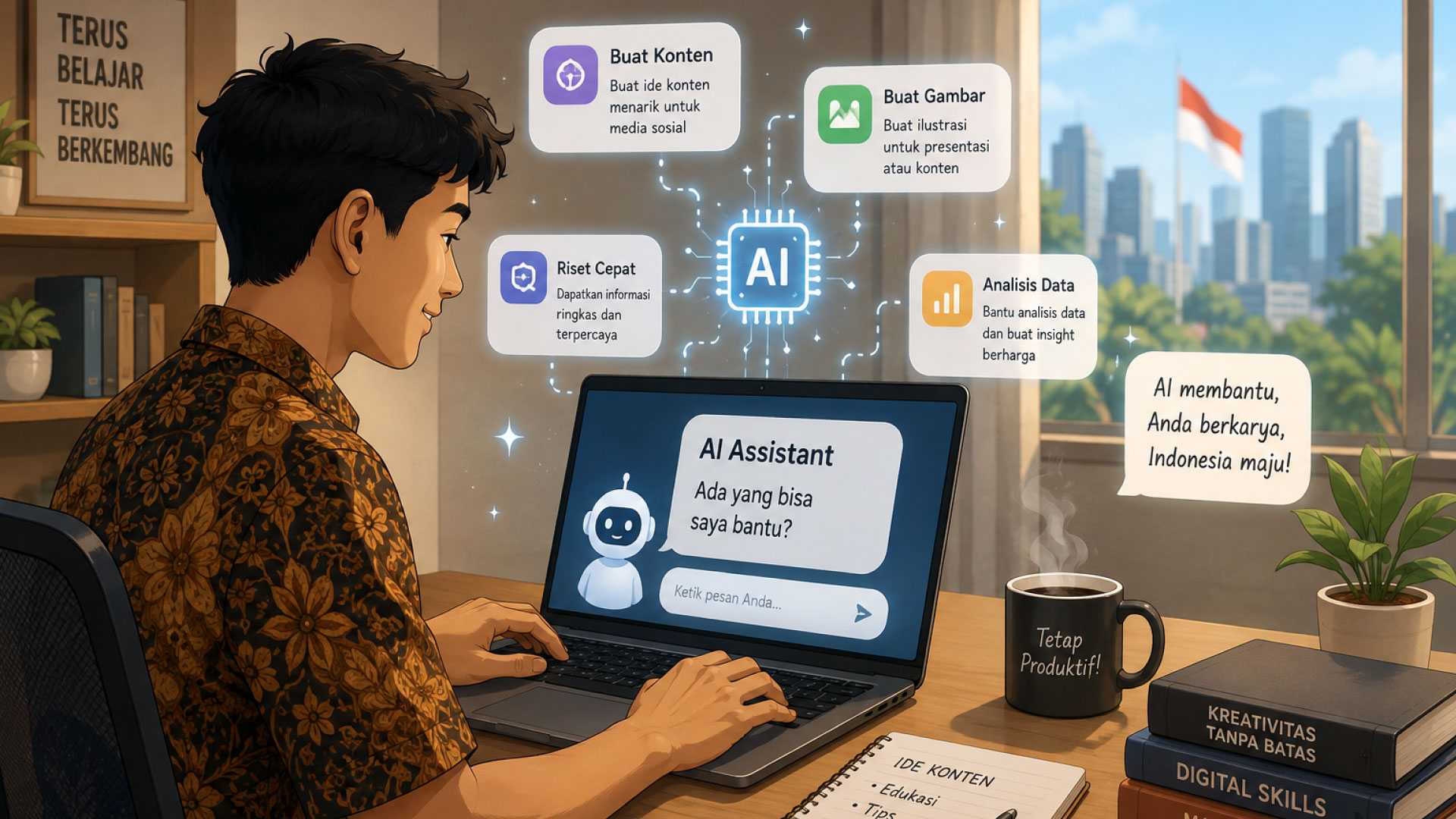
AI is no longer something discussed only at technology conferences or used by programmers. In Indonesia, artificial intelligence is increasingly becoming part of everyday work and routines—from finding ideas and writing content to summarizing documents, creating presentations, translating languages, and helping people make decisions.
Konsultasi GRATIS tanpa Komitmen, dan temukan strategi terbaik untuk bisnis Anda.
CHAT SEKARANGSo the question is no longer simply, “Are Indonesians using AI?” The more interesting question is: “How deeply has AI become part of our daily habits?” Recent data suggests the answer may be more surprising than we think.
According to the Microsoft Work Trend Index 2026, 33% of workers in Indonesia are now categorized as Frontier Professionals—advanced AI users who have integrated AI more strategically into their work. That figure is more than twice the global average of 16%.
What makes this particularly interesting is that AI use among this group goes far beyond asking a chatbot to write an email or summarize a document. 72% of AI users in Indonesia say they can now produce work they could not have produced a year ago. Among Frontier Professionals, that number rises to 82%.
This suggests that AI is doing more than simply making work faster. For some Indonesian workers, AI is expanding what they are capable of producing in the first place. It is gradually becoming less of a productivity tool and more of a digital capability amplifier.
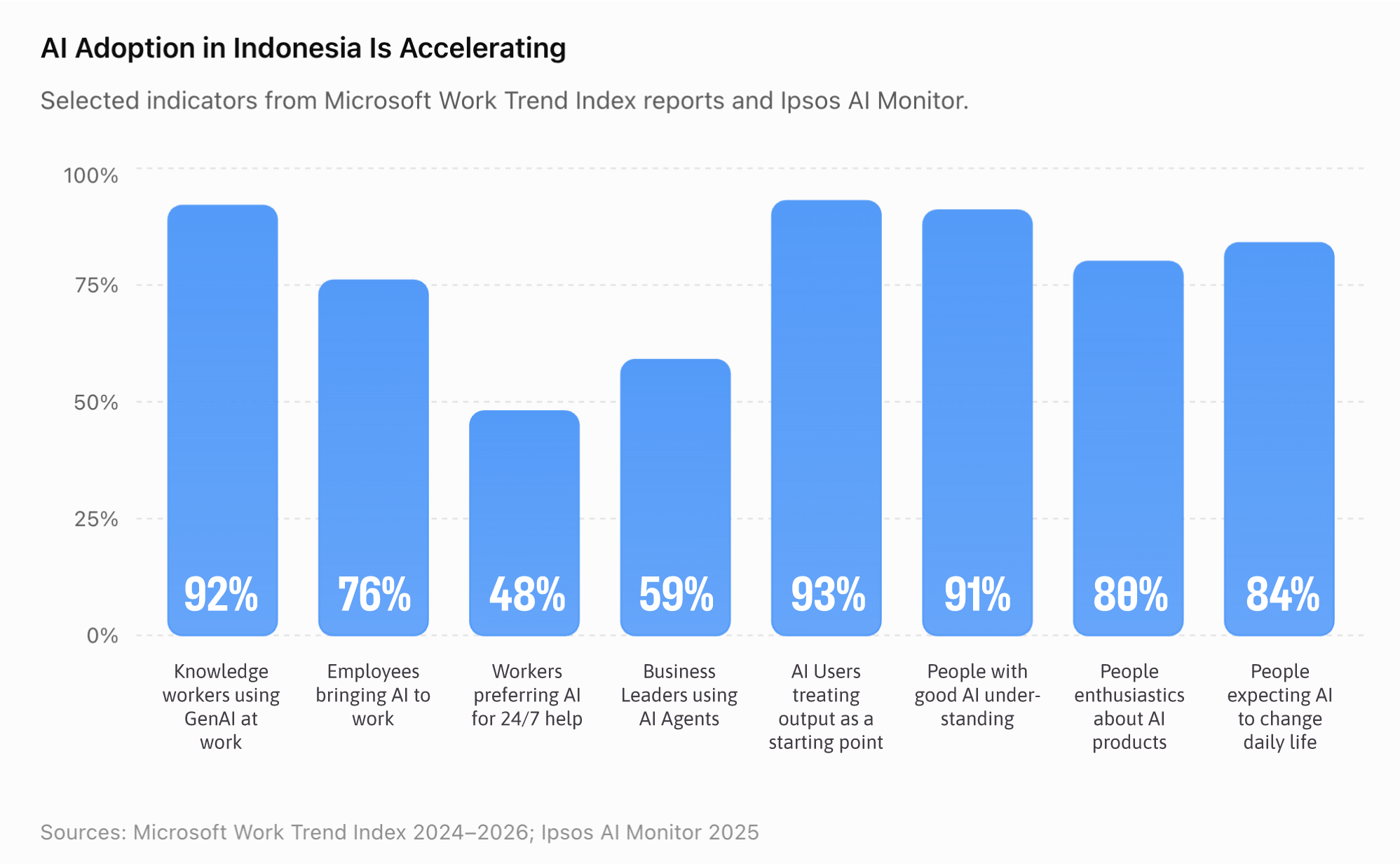
The trend is not entirely new. Microsoft’s Work Trend Index 2024 found that 92% of knowledge workers in Indonesia were already using generative AI at work. That was significantly higher than the global average of 75% and the Asia-Pacific average of 83%.
Even more interestingly, 76% of Indonesian employees reported bringing their own AI tools to work, a phenomenon known as Bring Your Own AI or BYOAI. This suggests that AI adoption is not always driven by company policy. In many cases, employees themselves are discovering AI tools and finding ways to incorporate them into their work.
This creates a fascinating pattern of adoption. People try an AI tool, discover that it saves time or improves their work, and then start using it repeatedly. What begins as experimentation gradually becomes a habit, and eventually becomes part of the workflow.
The shift is becoming even more visible. Microsoft’s Work Trend Index 2025 found that 48% of Indonesian workers would prefer using AI rather than asking a colleague for help because AI is available 24/7. Meanwhile, 38% said AI is particularly useful for generating ideas and supporting creative thinking.
These numbers reveal a subtle change in how people perceive AI. It is no longer simply software that you open when you need it. For many workers, AI is beginning to resemble a digital coworker that is always available.
There is no need to wait for a meeting, find someone who is available, or postpone a task until the next day. You can simply ask, explore an idea, challenge an assumption, or request another perspective.
Businesses are beginning to move in the same direction. In 2025, 59% of business leaders in Indonesia said their organizations were already using AI agents to automate workflows. That figure was slightly higher than the Asia-Pacific average of 53%.
This represents an important shift. AI is moving from being a tool used by individuals to becoming part of how organizations operate. Instead of simply helping employees write emails or generate ideas, AI is increasingly being explored for research, customer service, data analysis, automation, and other business processes.
But higher AI adoption does not necessarily mean Indonesians are blindly trusting AI. In fact, recent data suggests quite the opposite. 93% of AI users in Indonesia say they use AI output as a starting point rather than a final answer.
That figure is higher than the global average of 86%. It suggests that many Indonesian AI users understand that AI-generated output still needs to be reviewed, refined, and adapted to the context.
In other words, AI may help start the thinking process, but humans still make the final call.
This is consistent with findings from the Ipsos AI Monitor 2025. In a survey of more than 23,000 people across 30 countries, 91% of respondents in Indonesia said they had a good understanding of AI—one of the highest levels reported in the Asia-Pacific region.
Indonesians are also highly optimistic about the technology. 80% of respondents said they are enthusiastic about AI-powered products and services, while 84% believe AI will significantly change their everyday lives over the next three to five years.
But there is an important gap hiding behind these impressive numbers.
In 2025, 87% of Indonesian business leaders said they were familiar with AI agents, compared with only 56% of employees. That is a 31% gap, suggesting that AI adoption and AI understanding are not necessarily progressing at the same speed across an organization.
This is where the next challenge begins.
Companies cannot simply provide access to AI tools and expect transformation to happen automatically. Employees also need to understand how to use AI effectively, how to evaluate its output, how to protect sensitive information, and when human judgment needs to take over.
The answer is more complicated than a single national percentage. Current research comes from different surveys, populations, and definitions. For example, Microsoft’s 92% figure refers specifically to knowledge workers, not the entire Indonesian population. But when these different datasets are viewed together, a clear pattern begins to emerge. AI adoption is moving from curiosity → experimentation → habit → workflow. And some Indonesian workers are already entering the next stage:
A few years ago, someone might have opened ChatGPT simply to see what it could do. Can it write a poem? Can it create an image? Can it translate a paragraph? Can it write code? Today, the questions are becoming more sophisticated.
“Analyze this data.”
“Review this proposal.”
“Give me three possible strategies.”
“Help me identify the weaknesses in this concept.”
That change in the questions people ask may be more important than the number of people using AI. Because AI adoption is not just about how many people use the technology. It is also about how people work with it. AI is evolving from a tool for getting answers into a tool for thinking, exploring possibilities, challenging ideas, and creating things faster. This is why the bigger question for Indonesia may no longer be, “How many people are using AI?”
It may be: “How deeply will AI become integrated into the way Indonesians work, learn, create, and do business?” Will AI remain something people use to write captions and presentations? Or will it become part of decision-making, product development, customer service, business operations, and everyday workflows? Indonesia appears to be moving quickly toward the latter.
We may not yet be able to say that every Indonesian uses AI every day. But the available data makes one thing increasingly clear: AI has already moved far beyond the experimental stage. For a growing number of Indonesians, AI is becoming part of how work gets done. And ultimately, the AI race may not be about who uses AI the most. It may be about who knows how to combine AI with creativity, experience, judgment, and human intelligence most effectively.
Because perhaps, a few years from now, using AI every day will no longer feel special. Just like opening Google, checking email, or using a smartphone. AI simply becomes part of how we work.
Sources:
Microsoft Work Trend Index 2024, Microsoft Work Trend Index 2025, Microsoft Work Trend Index 2026, and Ipsos AI Monitor 2025.





Recommended for you
AI Usage in Indonesia: What the Data Reveals About Adoption, Usage Patterns, and Integration Readiness
The Best Power-Ups and Boosters in Ducky Pop: When and How to Use Them
The Hydrogen Fuel Frontier: Aryanto Misel's Nikuba Tech Shakes the World
The Psychology Behind Match-3 Games: Why Ducky Pop is So Addictive
Feeding the Future: Tackling Global Food Security with AI Agriculture
Ducky Pop: A Splash in the Match-3 Pool
From Idea to Launch: A Step-by-Step Guide to Building Your Dream Startup
The Digital Revolution: How Mobile Apps Have Transformed Our Daily Lives
Ducky Pop: A Splash in the Match-3 Pool
Unlock the Hidden Worlds: Exploring the Different Themes and Levels in Ducky Pop
Tonework: The Future of Personalized Beauty is Here
Typography Tips That Wow: How to Use Fonts Like a Pro
The Future of Website Design: AI-Driven Tools Transforming User Experience
The Power of Data Analytics: How to Drive Growth with Informed Decisions
From Zero to Branded Hero: How Print-on-Demand Empowers Small Businesses